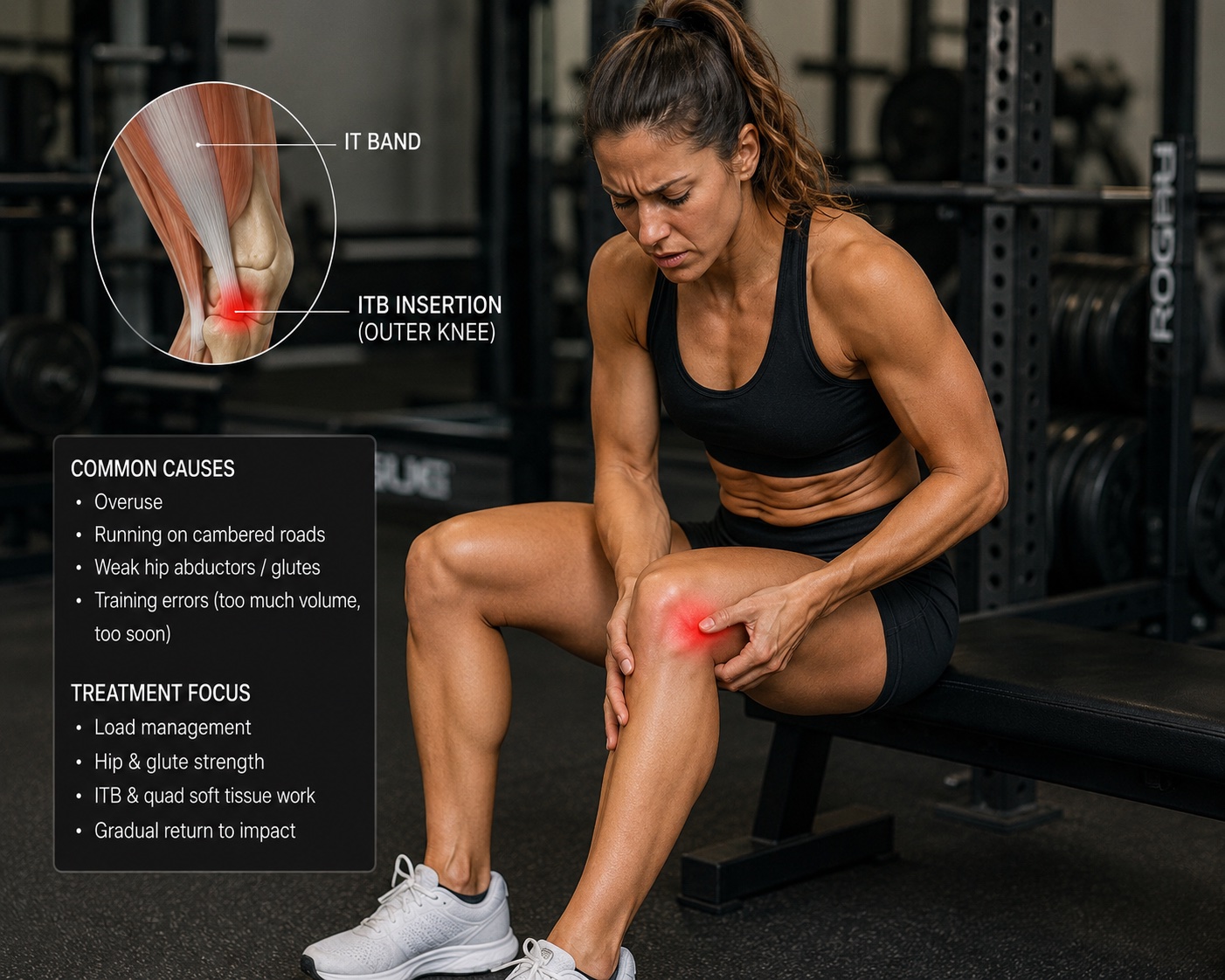
Pain on the outside of the knee is one of the most common complaints among runners.
Whether you’re training for your first 5 km, preparing for a marathon, tackling trails, or simply trying to stay active, pain around the outer aspect of the knee can quickly derail your progress.
One of the most common causes of this type of pain is Iliotibial Band Syndrome (ITBS).
ITBS has traditionally been viewed as a frustrating and stubborn injury. Many runners are told they simply need to stretch more, foam roll harder, or stop running altogether. Modern research suggests the story is more complex—and more hopeful.
With appropriate management, most runners can successfully return to running and sport. The key is understanding why ITBS develops, what contributes to it, and how to gradually rebuild the tissue’s capacity.
What Is Iliotibial Band Syndrome?
The iliotibial band (ITB) is a thick band of connective tissue that runs along the outside of the thigh. It originates from the pelvis and receives contributions from muscles including the tensor fascia lata (TFL) and gluteus maximus before attaching below the knee at the tibia.
The ITB plays an important role in:
- Pelvic stability
- Hip control during walking and running
- Control of knee movement
- Energy transfer during running
ITBS occurs when pain develops around the outer aspect of the knee, typically near the lateral femoral epicondyle.
For many years, ITBS was described as a “friction syndrome” in which the ITB repeatedly rubbed back and forth over the outside of the femur. While this theory dominated sports medicine for decades, more recent anatomical and biomechanical research has challenged this explanation.
Fairclough and colleagues demonstrated that the ITB is firmly anchored to the femur and does not simply slide backwards and forwards as previously thought. Instead, they proposed that compression of highly innervated fat and connective tissues beneath the ITB may be responsible for symptoms in many patients.
In simple terms, the problem may not be the ITB itself rubbing, but rather sensitive tissues beneath the ITB becoming irritated when exposed to excessive load.
How Common Is ITBS?
ITBS is one of the most common running-related injuries.
Research suggests that ITBS accounts for approximately 5–14% of all running injuries, making it one of the leading causes of lateral (outside) knee pain among runners.
While distance runners are most commonly affected, ITBS is also seen in:
- Trail runners
- Cyclists
- Football players
- Triathletes
- Hikers
- Military personnel
The condition can affect beginners and experienced athletes alike.
Interestingly, many runners develop ITBS during periods of increased training rather than during periods of consistent training. This highlights the importance of load management rather than simply blaming anatomy or biomechanics alone.
What Causes ITBS?
There is rarely a single cause.
Most cases develop when multiple factors combine to create a load that exceeds the tissue’s current capacity.
Think of ITBS less as an injury caused by one specific structure and more as a mismatch between what the body is being asked to do and what it is currently prepared to tolerate.
Training Errors: The Biggest Contributor
If there is one factor that repeatedly appears in both research and clinical practice, it is training load.
Common examples include:
- Increasing weekly mileage too quickly
- Adding hill training
- Introducing speed sessions
- Increasing training frequency
- Returning to running too aggressively after a break
- Sudden changes in terrain
- Training through fatigue
The body adapts remarkably well when load increases gradually.
Problems often arise when the rate of increase outpaces the body’s ability to adapt.
Many runners can identify a clear trigger such as:
“I started doing hill repeats.”
“I increased my long run.”
“I signed up for a race and doubled my mileage.”
“I started running again after being injured.”
These situations frequently precede the onset of ITBS.
Hills, Speed Work and Cambered Roads
Certain training environments can increase stress around the lateral knee.
Hills
Running uphill increases demand on the hip musculature and may alter loading patterns through the ITB.
Downhill running can be particularly provocative because of the increased eccentric control required around the knee and hip.
Many runners notice symptoms beginning shortly after introducing hill training.
Speed Work
Faster running increases force production requirements.
When speed sessions are added too aggressively, tissues that previously tolerated training may become overloaded.
Cambered Roads
Road camber refers to the slope built into roads for drainage.
Running repeatedly on heavily cambered surfaces may alter lower limb mechanics and contribute to asymmetrical loading patterns.
While road camber alone is rarely the sole cause of ITBS, it may contribute when combined with other risk factors.
The Role of Hip Strength and Pelvic Stability
One of the most influential studies investigating ITBS was published by Fredericson and colleagues in 2000.
The researchers found that runners with ITBS demonstrated significantly reduced hip abductor strength on the affected side.
Following a strengthening program, participants showed improvements in hip strength and successfully returned to running.
This study helped shift attention toward the importance of hip function in runners with ITBS.
Why does this matter?
During running, the gluteal muscles help:
- Control pelvic position
- Limit excessive hip adduction
- Control inward collapse of the knee
- Improve force transfer through the lower limb
When these systems become fatigued or underperform, loads may be transferred differently through the hip and knee.
This does not mean every runner with ITBS has weak glutes.
However, it does suggest that hip strength and pelvic control deserve careful assessment.
Could Your Lower Back Be Contributing?
The knee does not function in isolation.
The hip, pelvis, lower back and trunk all influence movement throughout the lower limb.
Reduced lumbopelvic control may influence:
- Hip positioning
- Running mechanics
- Pelvic stability
- Force transfer through the leg
In some individuals, stiffness, weakness or dysfunction within the lumbar spine and pelvis may contribute to altered movement patterns.
This is one reason why thorough assessment is important.
A clinician who only examines the painful area may miss important contributing factors elsewhere in the kinetic chain.
Running Technique Matters
Running technique is another factor worth considering.
Research has identified several biomechanical characteristics that may be present in some runners with ITBS.
These include:
- Excessive hip drop
- Increased hip adduction
- Increased knee internal rotation
- Over-striding
- Reduced cadence
One commonly observed pattern is excessive inward movement of the knee during running.
Some runners benefit from gait retraining strategies such as:
- Slightly increasing step rate
- Improving pelvic control
- Reducing over-striding
- Improving single-leg stability
A modest increase in cadence (often around 5–10%) may reduce loading through the lateral knee in some runners.
Importantly, gait retraining should be individualised rather than applied universally.
Why ITBS Can Take So Long To Recover
One of the most frustrating aspects of ITBS is its tendency to linger.
Athletes often expect symptoms to disappear within a week or two.
Unfortunately, recovery is not always that quick.
Factors influencing recovery include:
- Duration of symptoms
- Severity of irritation
- Ongoing training errors
- Running mechanics
- Recovery habits
- Sleep quality
- Strength deficits
- Compliance with rehabilitation
Some runners improve within several weeks.
Others may require several months before comfortably returning to their previous training loads.
The encouraging news is that most cases improve with a structured, progressive approach.
Should You Stop Running Completely?
Usually not.
For many runners, complete rest is neither necessary nor desirable.
Modern rehabilitation often focuses on finding an appropriate training level that allows symptoms to settle while maintaining fitness.
Many clinicians utilise pain-monitoring systems.
A common principle is:
- Mild symptoms during activity may be acceptable.
- Symptoms should not progressively worsen during activity.
- Symptoms should settle back to baseline within approximately 24 hours.
This approach allows many athletes to remain active while gradually rebuilding capacity.
What About Foam Rolling?
Foam rolling is one of the most commonly recommended treatments for ITBS. However, current thinking has become more cautious. The ITB itself is an exceptionally strong structure. Research suggests that rolling is unlikely to physically “break up adhesions” or significantly alter the tissue. While many runners report temporary relief following foam rolling, others report increased irritation. Aggressive rolling directly over an already sensitive area may temporarily increase pain.
For this reason, many chiropractors, physiotherapists and sports medicine practitioners now place greater emphasis on:
- Load management
- Strength training
- Movement quality
- Running progression
- Recovery strategies
rather than relying heavily on painful rolling techniques.
Evidence-Based Treatment Principles
Successful management usually combines several components.
1. Reduce Irritation
Initially it may be necessary to temporarily reduce:
- Hills
- Speed work
- Long runs
- High-volume training
The goal is not complete inactivity.
The goal is reducing excessive irritation.
2. Maintain Fitness
Cross-training may help maintain conditioning.
Options may include:
- Swimming
- Deep-water running
- Pool running
Some individuals tolerate cycling well.
Others find it aggravates symptoms.
3. Improve Strength and Control
Rehabilitation often focuses on:
- Hip abductors
- Gluteal musculature
- Pelvic stability
- Single-leg control
4. Gradual Return to Running
Running progression should be systematic.
Many athletes benefit from:
- Walk-run intervals
- Gradual mileage increases
- Delayed introduction of hills
- Delayed introduction of speed work
What Does The Research Say About Injections?
Gunter and Schwellnus published a randomised controlled trial in 2004 investigating corticosteroid injection for acute ITBS.
The study found that corticosteroid injection reduced pain in the short term compared with placebo.
Importantly, however, injections do not address the underlying factors that contributed to symptom development.
Load management, rehabilitation and addressing contributing factors remain essential components of long-term recovery.
Can High Intensity Laser Therapy Help?
High-intensity laser therapy has become increasingly popular in sports medicine settings.
While rehabilitation remains the cornerstone of treatment, some clinicians utilise laser therapy to help reduce pain and improve comfort during the early stages of recovery.
Reduced pain around the ITB and ITB insertion may help some individuals tolerate rehabilitation exercises and graded return-to-running programs more comfortably.
Laser therapy should generally be viewed as one component of a comprehensive treatment plan rather than a stand-alone solution.
When Should You Seek Professional Help?
If symptoms are:
- Persisting
- Recurrent
- Limiting training
- Affecting daily activities
- Preventing return to sport
a professional assessment is worthwhile.
A thorough evaluation should consider:
- Training load
- Running history
- Footwear
- Strength
- Pelvic stability
- Running mechanics
- Hip function
- Lower back function
- Recovery habits
Understanding why the problem developed is often more important than simply treating where it hurts.
How Spine Sport Feet May Be Able To Help
At Spine Sport Feet, our chiropractors regularly assess runners experiencing iliotibial band syndrome and other running-related injuries.
Assessment may include:
- Running history review
- Training load analysis
- Hip and pelvic strength assessment
- Lower back and pelvic examination
- Movement assessment
- Rehabilitation planning
- Return-to-running guidance
Where appropriate, management may also include high-intensity laser therapy as part of a broader rehabilitation strategy.
Most importantly, our goal is to identify the factors contributing to your symptoms and help guide you safely back to the activities you enjoy.
If you are experiencing persistent pain on the outside of your knee, seeking advice early may help prevent a short-term problem from becoming a long-term frustration.
To find out more about Iliotibial band syndrome, or to make an appointment, please call us on (07)5580 5655 or book online at https://spinesportfeet.com.au/booking/.
References
- Fredericson M, Cookingham CL, Chaudhari AM, Dowdell BC, Oestreicher N, Sahrmann SA. Hip abductor weakness in distance runners with iliotibial band syndrome. Clin J Sport Med. 2000;10(3):169-175.
- Gunter P, Schwellnus MP. Local corticosteroid injection in iliotibial band friction syndrome in runners: a randomised controlled trial. Br J Sports Med. 2004;38(3):269-272.
- Fairclough J, Hayashi K, Toumi H, Lyons K, Bydder G, Phillips N, et al. Is iliotibial band syndrome really a friction syndrome? J Sci Med Sport. 2007;10(2):74-76.
- van der Worp MP, van der Horst N, de Wijer A, Backx FJG, Nijhuis-van der Sanden MWG. Iliotibial band syndrome in runners: a systematic review. Sports Med. 2012;42(11):969-992.
- Baker RL, Souza RB, Fredericson M. Iliotibial band syndrome: soft tissue and biomechanical factors in evaluation and treatment. PM&R. 2018;10(1):95-106.
- Ellis R, Hing W, Reid D. Iliotibial band friction syndrome—a systematic review. Man Ther. 2007;12(3):200-208.